
It takes 10 minutes of warmup for measurements to stabilize to a standard deviation of 1.2-1.5 ppbv. After 30 minutes of warmup, measurements are within 2 ppbv of the true values.
Startup and Operation of Ozone Monitors at Low Temperatures
Date: 12 August 2005
Author: John Birks
Question Addressed
2B Tech Ozone Monitors are often employed in low temperature environments.
The data provided here were obtained for evaluation of the use of Model 202
Ozone Monitors on ocean buoys in the Arctic where the seawater temperature is
near 0 °C. In order to conserve power, the instruments can only be turned on for
short periods of time. The results reported allowed us to determine how long it
takes for ozone measurements to stabilize following a cold start at near freezing
conditions. The results also demonstrate that the mercury lamp will ignite at a
temperature at least as low as 1 °C without any external heat applied.
Experimental
A Model 202 Ozone monitor was placed in an ice chest with a Teflon-lined
sampling tube extending outside the ice chest for an hour or more. This allowed
the temperature of the entire instrument to fall to 1-3 °C. The Ozone Monitor was
then powered on and sampling begun of either ozone-scrubbed air or air
containing approximately 50 ppb of ozone. Data were obtained for 30 minutes.
Duplicate runs were carried out for ozone-scrubbed air and for air containing 50
ppb ozone.
Results
The results of the experiments are summarized in Figs. 1-4. The measurements
were erratic for up to the first 10 minutes as the lamp warmed up. Following 10
minutes, standard deviations of the detrended data were in the range 1.2-1.5
ppbv; i.e., the precisions were within the normal specifications of the Model 202
Ozone Monitor (1.5 ppbv). During the period 10-30 minutes, there was a slight
trend, either up or down of less than 0.19 ppbv/minute (i.e., no more than 3.8
ppbv change in 20 minutes). After 30 minutes of warmup, both the zero and the
50 ppbv ozone measurements were within 2 ppbv of the true values.
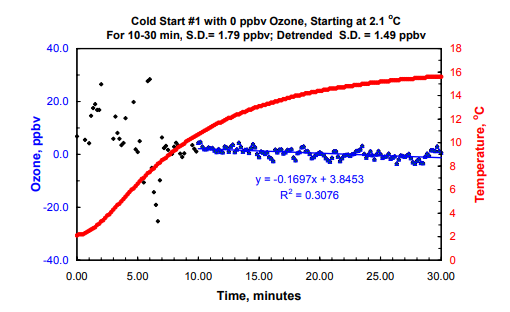
Fig. 1. Results for Cold Start #1 with sampling of ozone-scrubbed air. The initial detection cell
temperature was 2.1 °C. Black data points are ozone measurements during the first 10
minutes. Blue data points are ozone measurements after 10 minutes. Red data points
are measurements of the cell temperature. The trend line applies to the ozone data after
10 minutes of warmup. Measured ozone at 30 minutes is 0.4 ppbv.
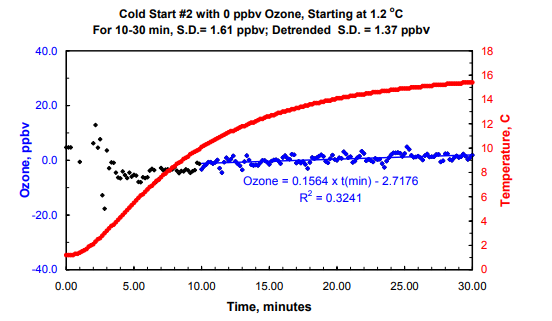
Fig. 2. Results for Cold Start #2 with sampling of ozone-scrubbed air. The initial detection cell
temperature was 1.2 °C. Black data points are ozone measurements during the first 10
minutes. Blue data points are ozone measurements after 10 minutes. Red data points
are measurements of the cell temperature. The trend line applies to the ozone data after
10 minutes of warmup. Measured ozone at 30 minutes is 0.5 ppbv.
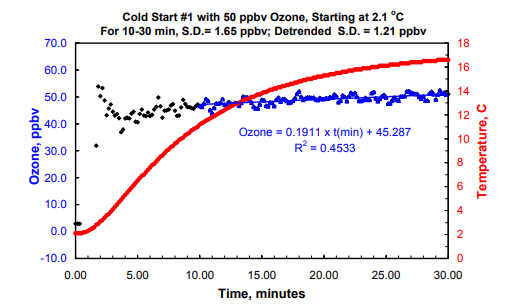
Fig. 3. Results for Cold Start #1 with sampling of air containing 50 ppb ozone. The initial
detection cell temperature was 2.1 °C. Black data points are ozone measurements
during the first 10 minutes. Blue data points are ozone measurements after 10 minutes.
Red data points are measurements of the cell temperature. The trend line applies to the
ozone data after 10 minutes of warmup. Measured ozone at 30 minutes is 49.1 ppbv.
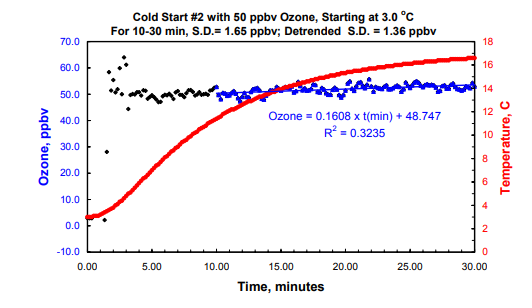
Fig. 4. Results for Cold Start #2 with sampling of air containing 50 ppb ozone. The initial
detection cell temperature was 3.0 °C. Black data points are ozone measurements
during the first 10 minutes. Blue data points are ozone measurements after 10 minutes.
Red data points are measurements of the cell temperature. The trend line applies to the
ozone data after 10 minutes of warmup. Measured ozone at 30 minutes is 51.9 ppbv.
Conclusions
These experiments demonstrate that the Model 202 Ozone Monitor will turn on at
1-3 °C and make measurements within the instrument specifications for precision
and accuracy after 30 minutes of warmup. Measurements possibly could be
made as soon as 10 minutes after powering up the instrument if small corrections
are made to the data. The results confirm that the instrument could be used for
intermittent measurements of ozone on ocean buoys.
This study represents an extreme case. Under moderate temperature conditions
of 10-40 °C, the required warmup time for accurate measurements with good
precision is 20 minutes or less.