
The Model 205 Ozone Monitor exhibits an overall zero drift of much less than 1 ppbv.
Baseline Stability for the Model 205 Ozone Monitor
Date: 8 June 2006
Author: John Birks
Question Addressed
Accurate measurements of ozone concentration require measurements of the
instrument “zero” in which the apparent ozone concentration is measured in
ozone-scrubbed air. It is desirable that the zero drift be small so that correction
for the zero offset need not be frequent. The following data were obtained with a
Model 205 Ozone Monitor in order to assess its baseline stability.
Experimental
The inlet of a Model 205 Ozone Monitor was attached to a calibration manifold
where it sampled air with and without ozone as follows:
1) Ozone-scrubbed ambient air (1.1 hours)
2) High ozone concentation (not a constant source), 1.1 hours
3) Ozone-scrubbed ambient air (1.1 hours)
4) Ambient air (1.7 hour)
5) Ozone-scrubbed ambient air (2.4 hours)
Results
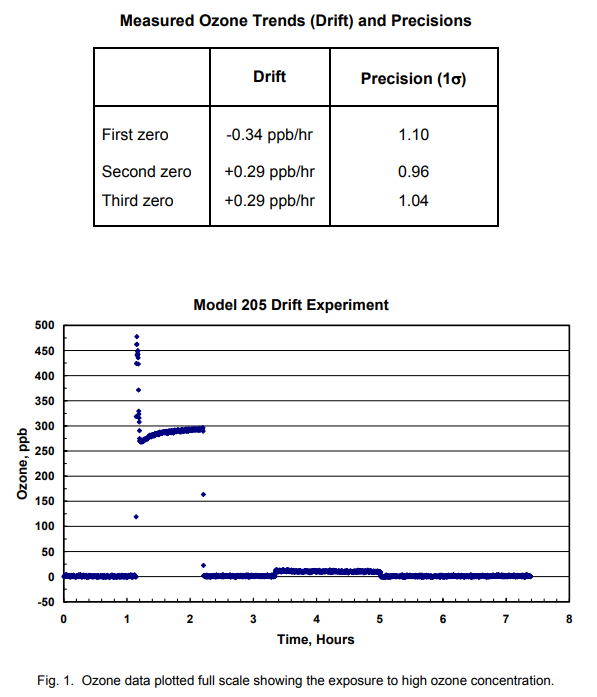
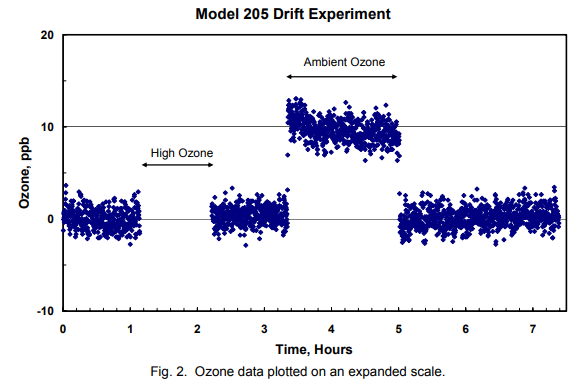
The results are graphed in the figure shown below. The data set includes zero
data before exposure to a high ozone concentration of 270-300 ppb (First Zero),
immediately after exposure to high ozone (Second Zero), and immediately after
exposure to room air (Third Zero). Linear regression was applied to the First,
Second and Third Zero to obtain the degree of degree of baseline drift in ppb/hr.
As, can been seen in the following summary, the absolute value of the drift was
always less than 0.34 ppb /hour, and the precision averaged 1.0 ppb without any
detrending of the data to account for drift. There was no significant effect on the
instrument of exposure to high ozone concentration or exposure to ambient air.
Conclusions
Over the 7.4-hour period tested, the Model 205 Ozone Monitor exhibited an
overall zero drift of much less than 1 ppbv. Exposures to high ozone
concentrations and to ambient air had no significant effect on the instrument
baseline.