
For accurate measurements, the flow rate needs to be sufficient to flush the cell adequately. At volumetric flow rates above 600 cc/min, the flow rate used has no significant effect on ozone measurements.
Effect of Flow Rate on Ozone Measurements: Correction Factors for Slow
Flow Applications
Date: 2 August 2006
Author: John Birks
Background
Some applications, such as chamber experiments where plants are exposed to
ozone, require low sampling flow rates. The small volume of the detection cell
used in 2B Tech Ozone Monitors makes our instruments well suited to slow flow
applications.
For accurate measurements, the flow rate needs to be sufficient to flush the cell
adequately between the Beer-Lambert Law measurements of light intensity I
(sample air) and Io (ozone scrubbed air). At volumetric flow rates above 600
cc/min, the flow rate used has no significant effect on ozone measurements. As
shipped, the Model 202 Ozone Monitor samples air at a volumetric flow rate of
typically, 800 cc/min. For slow flow applications, the flow rate can be reduced by
use of a needle valve inserted in-line just prior to the air pump and a correction
factor applied by increasing the slope calibration factor S in the instrument menu.
The necessary correction factors are provided here.
Experimental
The sampling flow rate of a freshly calibrated Model 202 Ozone Monitor was
varied by use a needle valve inserted in-line just prior to the air pump. A
concentration of 300 ppb ozone was generated in a calibration manifold and
sampled simultaneously by the 2B Tech standard instrument and by the Model
202 Ozone Monitor. Measurements were recorded as a function of sampling
flow rate for both instruments, and a correction factor calculated for the modified
Ozone Monitor.
Results
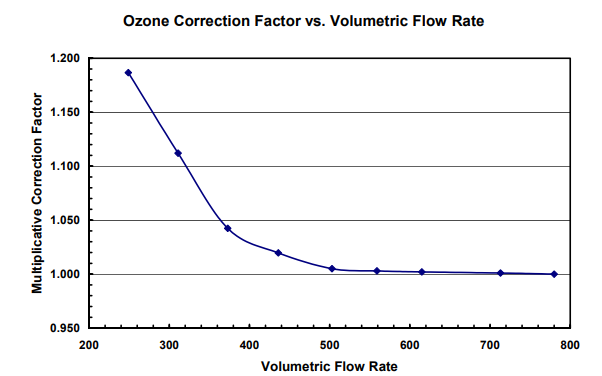
The calibration factors obtained are given in tabular form below and plotted in the following figure.
| Flow Rate cc/min, volumetric |
Correction Factor* |
|
249 |
1.187 |
| 311 | 1.112 |
| 373 | 1.042 |
| 436 | 1.020 |
| 503 | 1.005 |
| 559 | 1.003 |
| 615 | 1.002 |
| 713 | 1.001 |
| 780 | 1.000 |
*To apply the correction factor, multiply the slope (S) calibration factor of your instrument by the correction factor given, and enter the new S value using the instrument menu.
Conclusions
Without software modifications, the Model 202 Ozone Monitor can be operated
down to 300 cc/min with not more than about a 12% correction factor.
By increasing the length of the measurement cycle (e.g., by increasing the time
between measurements to 20 s instead of 10 s), it is possible to even further
reduce the required flow rate. However, this requires custom software. Please
contact us if you would like a custom modification of your instrument for slow flow
measurements.
The Model 205 Dual Beam Ozone Monitor requires twice the flow as the Model
202 because of its two detection cells. For this reason, the Model 202 Ozone
Monitor is preferred for slow flow applications. To estimate the effect of flow rate
on the Model 205, divide the measured volumetric flow rate by 2 and interpolate
the required correction factor in the above table and graph.