![2BTech_FavIcon-WHITE-OUTLINE.png]](https://kb.2btech.io/hs-fs/hubfs/2BTech_FavIcon-WHITE-OUTLINE.png?height=1412&name=2BTech_FavIcon-WHITE-OUTLINE.png)
Technical Note No. 042
Cleaning Procedure for Model 106-L Ozone Monitor
Date: 8 June 2016
Author: Chris Ennis
Summary:
It is recommended that Ozone Monitors be returned to 2B Tech at least once annually for
calibration. This includes cleaning of the entire flow path and installation of a new internal
ozone measurement scrubber (Figure 5.1 of the manual for the Model 106-L Ozone
Monitor). If the flow path becomes contaminated, as evidenced by large positive or
negative offset (Z) and/or low slope (S) calibration parameters, it may be necessary to
clean the flow path and replace the ozone measurement scrubber. This can be done by
the user if desired. The procedure involves the following steps:
1. Remove the top cover.
2. Bypass the ozone measurement scrubber.
3. Bypass the DewLine™ (Nafion tube).
4. Connect a drain tube at the exit of the detection cell.
5. Squirt methanol through the flow path while the instrument is running.
6. Blow dry with clean compressed air or nitrogen while the instrument is running.
7. Check the DewLine™ for contamination.
8. Replace the ozone measurement scrubber.
9. Reconnect plumbing.
Tools needed:
-Philips head screwdriver
-Teflon®-lined Tygon® or other clean, inert tubing such as PTFE, PFA or PVDF
-Methanol (methyl alcohol)
-Squirt bottle
-New ozone measurement scrubber
Please refer to Figure 5.1 of the Ozone Monitor Model 106-L manual as you go through
this cleaning procedure.
Warning: This procedure makes use of the toxic and flammable solvent methanol, and
appropriate care should be taken. Although a relatively safe solvent to work with, as
with all solvents appropriate care should be taken. Remove any clothing contaminated
with methanol. If methanol contacts your skin, wash the affected areas with soap and
water for at least 15 minutes. If methanol gets in your eyes, wash your eyes with water
for at least 15 minutes, occasionally lifting and lowering the upper and lower eyelids and seek medical help.
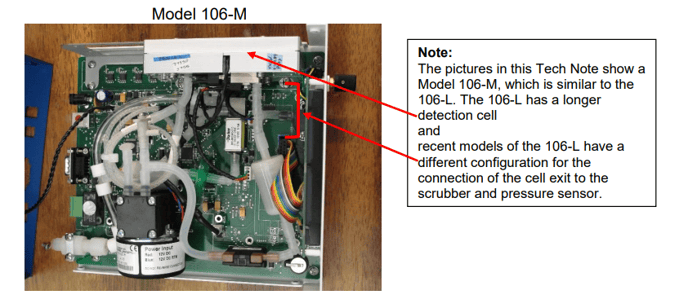
Procedure:
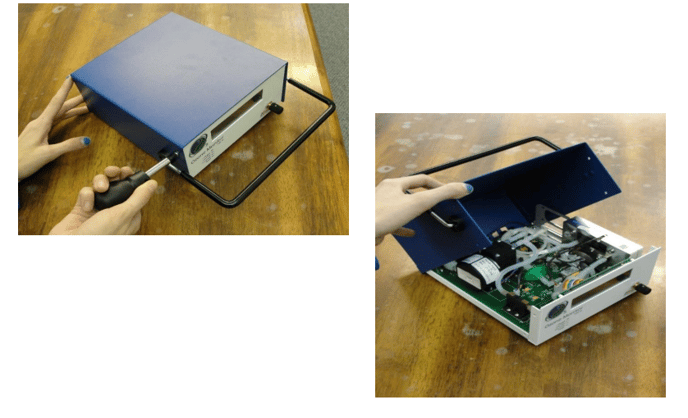
1. Remove 6 screws from top cover. Remove cover (blue), from base (white).
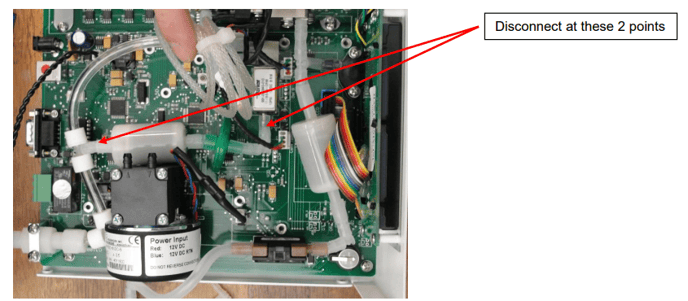
2. Bypass the ozone measurement scrubber and disc particle filter by disconnecting both
ends of the scrubber and replacing with a short piece of clean, inert tubing such as
Teflon-lined Tygon®, PTFE, PFA or PVDF. Do not use Tygon!
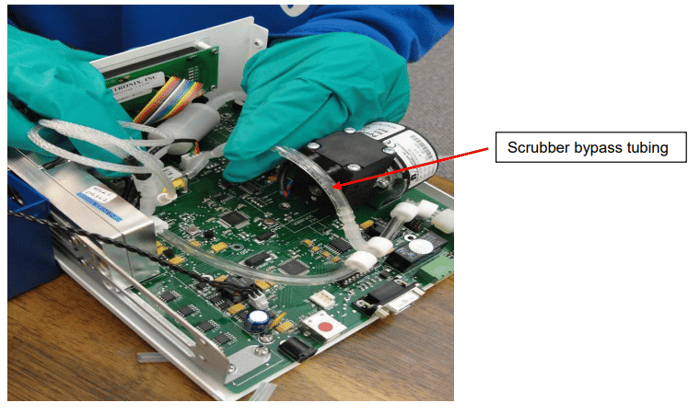
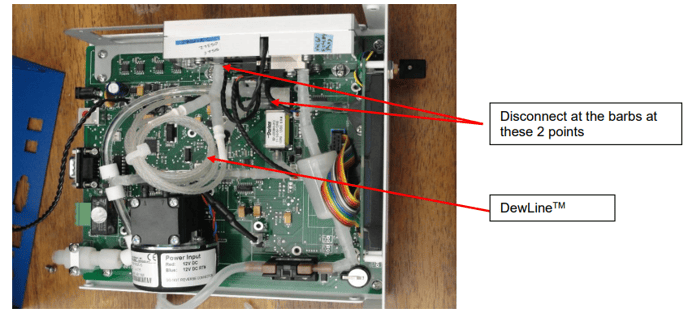
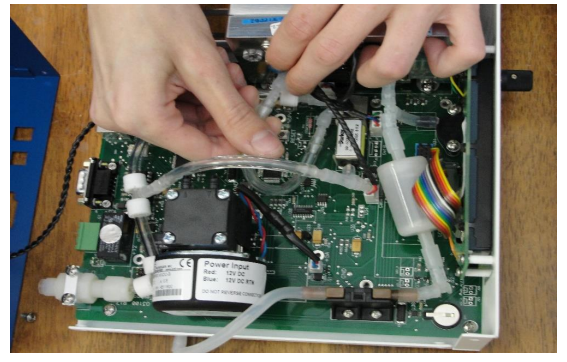
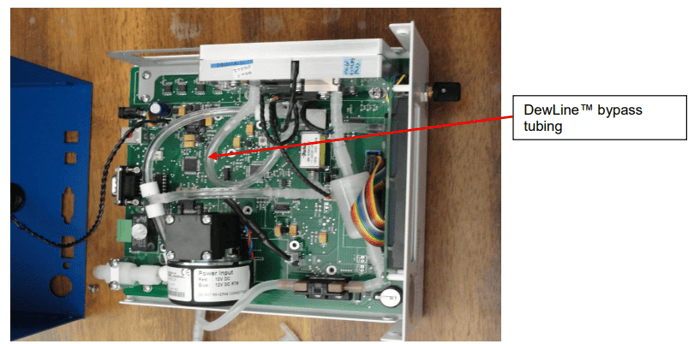
3. Remove the DewLine™ at both ends and replace it with clean, inert bypass tubing
such as Teflon-lined Tygon®, PTFE, PFA or PVDF. Do not use Tygon!
Note that the DewLine™ consists of two sections of Nafion® tubing connected in
parallel.
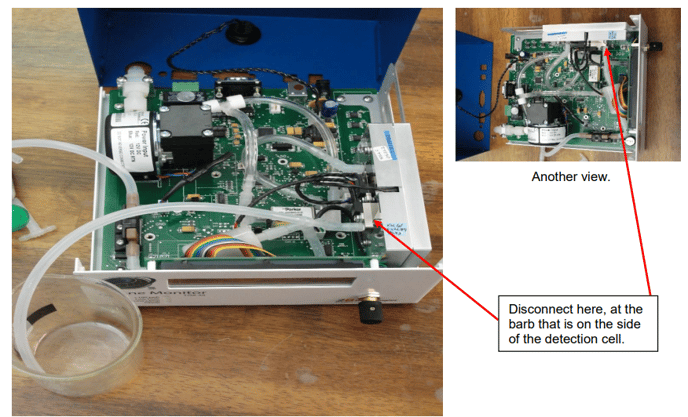
4. Disconnect the tubing from the outlet of the detection cell and replace with a drain
tube. The drain tube can be any kind of tubing; silicone tubing is shown here.
5. Put on goggles and plastic or rubber gloves. Carry out the cleaning procedure in a hood or well ventilated area. Make sure there are no sparks or flames nearby.
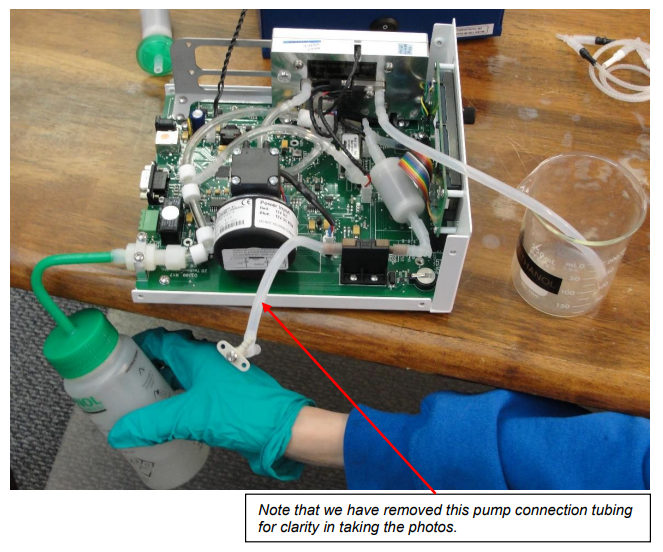
Use a squirt bottle to force methanol through the flow path while the instrument is
running. You should pass at least 50 cc of methanol through the instrument. The
purpose of having the instrument running is to clean both sides of the 3-way solenoid
valve. This valve switches states every 2 seconds.
Collect the waste solvent and dispose of properly. Don’t pour methanol down a drain.
6. Dry the flow path with clean, compressed air or nitrogen. Be careful during this
step and use low pressure to begin with as large quantities of methanol will
spew out initially. IMPORTANT: It is necessary that the flow path be completely
dry before reconnecting the scrubber.
7. If the DewLine™ has become contaminated (as noted by discoloration), it should be
replaced, or returned to 2B Technologies for cleaning.
8. It is recommended that you replace the ozone measurement scrubber (the one you
bypassed) during this step. If the flow path was dirty, then the scrubber will be dirty
as well. A contaminated ozone measurement scrubber will typically cause a large
offset in the measurement and may re-contaminate the flow path. The ozone exhaust
scrubber on the opposite side of the instrument that protects the air pump may be
changed at this time as well, although that ozone scrubber has no effect on the ozone
measurement.
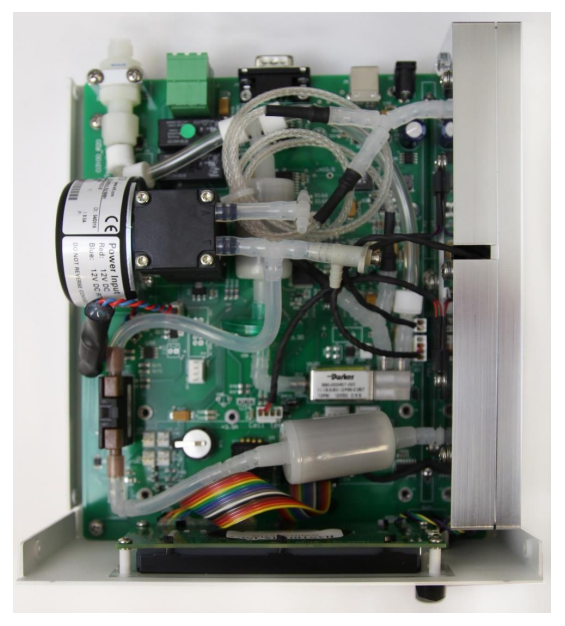
9. Reconnect the plumbing and replace the instrument covers. The assembled Model
106-L instrument is shown below as a guide. (Reproduction of photo from Figure 5.1
of the Model 106-L manual.)
10.We recommend that you run the instrument at least an hour or two after cleaning, to
ensure that it is thoroughly dry before you resume measurements. Place an external
ozone scrubber on the Model 106-L air inlet for this step.
Additional Cleaning:
When calibrated, the Ozone Monitor should have an offset (Z) in the range ±10 ppb and
preferably ±5 ppb. The slope calibration parameter (S) should be in the range 0.90-1.10 and preferably 0.94-1.06. Offsets and slopes outside this range are most often due to a contaminated flow path. Sometimes it requires more than one cleaning to correct a highly contaminated instrument. If methanol alone is not adequate, it is helpful to do a first cleaning with hexane and a second cleaning with methanol. All of the cautions concerning the use of methanol apply to hexane as well. If cleaning of the flow path in combination with replacing the ozone measurement scrubber does not correct the problem, please return the instrument to 2B Technologies. We will provide you with an estimate of any required repairs before doing the work.
If you have an ozone source, it is helpful to 1) clean the instrument with methanol, 2)
expose the instrument to high ozone levels (ppm and above) for several minutes to hours,
and 3) clean the instrument again with methanol. The ozone will oxidize contaminants to
form polar oxygen-containing compounds that are more soluble in methanol.
Note: You can check the zero of the instrument by running it with an external ozone
scrubber attached. Keep in mind that the external ozone scrubber must be clean;
otherwise, it will desorb UV-absorbing compounds and cause an apparent offset.