![2BTech_FavIcon-WHITE-OUTLINE.png]](https://kb.2btech.io/hs-fs/hubfs/2BTech_FavIcon-WHITE-OUTLINE.png?height=1412&name=2BTech_FavIcon-WHITE-OUTLINE.png)
Technical Note No. 069
Considerations for Solar Powered Instrumentation
Date: 03/07/2025
Author: Luke Greenidge
Reviewed: Gordon Pierce
Summary:
Reliable power is critical for remote air monitoring instrumentation, yet access to grid power in
isolated locations can be limited or non-existent. Solar power presents a viable and sustainable
solution, offering energy independence, reduced operational costs, and minimal environmental
impact. This white paper explores key considerations for implementing solar-powered systems
for remote air quality monitoring. This paper considers an AQLite manufactured by
2BTechnologies as an example when using solar as a power source.
Introduction
Traditionally, high-quality ambient ozone air monitoring has required a large amount of power, heavy physical infrastructure, and significant expenses. As high-quality instrumentation becomes more portable and lower in power consumption, non-traditional deployment opportunities
continue to expand. Solar power has been a common solution for low-cost sensors and other IoT
devices used in remote monitoring applications. However, while the power consumption for US
EPA Federal Equivalent Method (FEM)-grade air quality monitoring has decreased, it remains
significantly higher than that of smaller sensors.
Description of the Problem
The 2B Technologies AQLite is an air monitoring package housed in a weather resistant box that
includes a FEM ozone monitor as well as low-cost sensors. The AQLite is considered low power
compared to most FEM ozone monitors but still draws 12W in its standard configuration. In
comparison, most O3 electrochemical sensors (used primarily for industrial applications)
consume 2-3 orders of magnitude less power, depending on additional circuitry [1]. This means
that a 5-10W mini solar panel and very small battery, which may be sufficient for a sensor, is
inadequate for powering an AQLite.
Furthermore, air monitors are deployed worldwide in diverse environmental conditions,
including extreme heat, cold, and varying sunlight exposure. This variability means that an
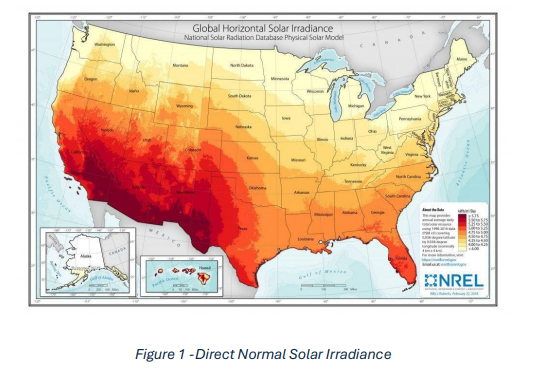
optimal solar system must be tailored to each location. For instance, a 100W solar panel in
Seattle, WA may generate 40-50% less power on average than the same panel in Albuquerque,
NM as it is at a higher latitude and a different environment. Figure 1 from the National
Renewable Energy Lab (NREL) displays Horizontal Solar Irradiance for the US which is the key
factor in many solar system calculators and varies substantially based on location [2]
Criteria
For most applications, instrumentation must be powered continuously to ensure data
completeness. Exact criteria will vary based on the instrument’s nominal power draw and project
requirements. Proper solar system sizing, either DIY using solar calculators or professional
consultation, is necessary to guarantee reliable power. Safety is also a critical factor as
undersized solar controllers, improper wire gauge, or incorrectly specified solar panels can
damage the solar installation, battery, or instrumentation. In extreme cases, improper installation can lead to fires or other hazards.
Solution – Example
Since the solutions for this problem are varied, an example solution will be examined for key
considerations. This project requires continuous measurements. This project utilizes an AQLite
which has sensors to measure carbon monoxide, carbon dioxide, particulate matter and GPS in
addition to FEM ozone readings and cellular data transmission. The AQLite draws 12W and
therefore, consumes 288Wh/day. Several solar calculators were used to determine the optimal tilt, battery size, and solar panel specifications. NREL’s PVWatts calculator is a great resource when planning for an installation [3].
Panel
In general, the panel needs to be specified for the shortest (least amount of sunlight) day of the
year, in the northern hemisphere this is typically sometime in late December. It is almost always
better to oversize the system rather than undersize.
• A 30 degree tilt will generate approximately 355Wh/day
• A 20-degree tilt generates approximately 320Wh/day
• A 0 degree (flat) tilt generates only 205Wh/day, which is insufficient for continuous
operation (as the AQLite draws 288Wh/day).
• A 45-degree tilt increases production to 385Wh but may reduce efficiency in summer
months at other locations
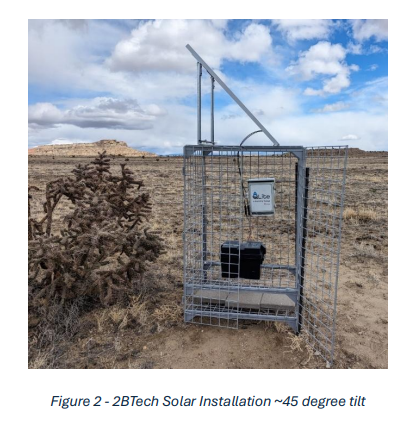
Typically, "over-tilting" the panel slightly is beneficial because the days are longer in the
summer. We tilted the panel at 45 degrees because the impact to the summertime output would
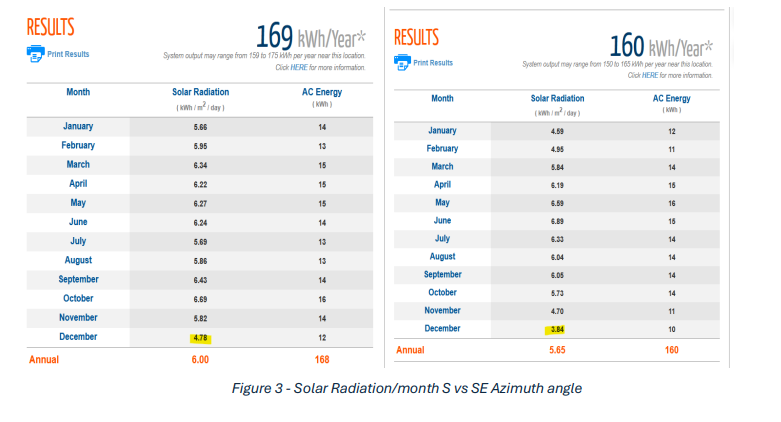
not be detrimental to our use case (Figure 2). The panel still outputs ~405Wh/day in July at a 45-
degree tilt (Figure 3).
Secondly, the panel orientation also affects power output. For optimal power output, the panel
must face South in the northern hemisphere and North in the southern hemisphere. Adjusting the Azimuth angle from 180 (S) to 135 degrees (SE) sees average output drop from
4.78kWh/m^2/day (or ~478Wh per 100W rated panel/day) down to ~384Wh/day (Figure 3).
Controller
The solar controller must be compatible with the solar panel and battery setup. Many vendors
offer controller and panel kits. Key specifications include:
• A "low voltage disconnect" (LVD) feature is required to prevent the battery from over- discharging, usually shutting off the load output just below 12V (battery voltage). Systems without this feature will damage equipment including the instrument and battery.
• Maximum current (Isc) and nominal voltage of the panel(s) must fall within the
controller’s allowable range.
• The charging voltage for the battery must be compatible with the battery or batteries. Usually, these controllers are designed for 12V, 24V, and 48V systems.
• The controller should include a battery terminal and a "load" terminal for the AQLite
power connection. This voltage out must be within the range of the AQLite which is 9-
36V DC.
• A Maximum Power Point Tracking (MPPT) controller is more efficient which allows for
systems with tighter specifications.
• If using lithium-based batteries, the controller must be compatible with lithium charging
requirements.
Battery
Battery sizing ensures reliable operation during periods of low sunlight. The battery capacity we
used for our installation is calculated as follows:
• 288Wh/day / 12V * 2 days = 48Ah for two days of backup power.
• Lead-acid batteries should not be discharged beyond 50% to prolong battery life, so the
required capacity is doubled to 96Ah.
For our project, a 100Ah AGM lead-acid battery was used due to its low maintenance
requirements. Flooded lead-acid batteries require periodic water refilling. Lithium batteries offer
higher energy density and are lighter in weight but are typically more expensive and will not
charge below freezing (unless heated). It is important to note that in locations with more severe
weather, 3-4 days of “battery backup” may be ideal to ensure continuous operation.
Other Considerations
Solar panels and lead acid batteries degrade over time. If a project is longer than 1-2 years, the
quality of the battery and solar panel becomes more important. Mounting and security of all
components in the system must be considered. For example, wildlife or people may interfere
with the installation. In this example project, we used a wire cage to house the AQLite, battery,
and controller, and then used stakes to secure the cage to the ground (Figure 2)
Conclusion
Solar-powered solutions offer a reliable, cost-effective, and sustainable method for powering
remote air monitoring instrumentation. By leveraging solar technology, organizations can ensure
continuous data collection in remote areas while reducing operational expenses and
environmental impact. Due to the diverse climate and locations of deployment, careful design
and planning is paramount to a successful project.
References
[1] Ozone Sensors (O3). (2025, February 13). https://www.alphasense.com/products/view-by-target-gas/ozone-sensors-o3
[2] Collection of NREL maps. Energy.gov. (2025, February 13).
https://www.energy.gov/eere/photos/collection-nrel-maps
[3] PVWatts - NREL. PVWatts Calculator. (2025, February 13).
https://pvwatts.nrel.gov/pvwatts.php