![2BTech_FavIcon-WHITE-OUTLINE.png]](https://kb.2btech.io/hs-fs/hubfs/2BTech_FavIcon-WHITE-OUTLINE.png?height=1412&name=2BTech_FavIcon-WHITE-OUTLINE.png)
Technical Note No. 013
Nitric Oxide Scrubber Capacity
Date: 27 May 2008
Author: Peter Andersen
Background
We have investigated the lifetime of the NO scrubbers used in our instruments.
The scrubbers are used to remove NO from ambient air, and if the NO scrubber has
been exhausted, the instruments will not perform to specification. This report details
scrubber lifetime calculations based on data in the scientific literature and scrubber
efficiency measurements after one year of service.
The NO scrubber is comprised of two different proprietary materials used in
series. The material that initially comes into contact with the air flow is a mix of metal
oxide catalysts that efficiently oxidizes nitric oxide to nitrogen dioxide. The second
material contains a mix of metal salts that removes nitrogen dioxide produced on the
initial scrubber material.
Calculated Scrubber Capacities using Data from the Scientific Literature
Several studies of the scrubber material have been reported for protecting workers from exposure to high concentrations of nitric oxide. In these reports, capacity values of 4-5 liters of NO at a flow rate of 8 L/min have been estimated for scrubbers made with 225 cc of each of the two scrubber materials used on 2B Tech instruments. In one study of these large scrubbers, the scrubber capacity was measured using 55-70 ppm NO and 9-12 ppm NO2 at a flow rate of 9 L/min. The capacity of the scrubber was measured to be 3.92 liters of nitric oxide.
The 2B Technologies NO scrubbers contain 5 cc of each material. Correcting for the difference in the amount of scrubber material, the 2B Tech scrubbers have an estimated capacity of 0.09 L of nitric oxide. In the case of scrubbing ambient air containing 100 ppb NO, a 2B scrubber is expected to scrub a volume of 9x10⁵ L of air. In an instrument drawing 1.0 L/min through the scrubber, the capacity can be divided by the flow rate to yield a scrubber lifetime of 625 days of continuous use.
Performance After Extended Use
Six scrubbers were tested after being used to scrub nitric oxide in ambient air monitors. The scrubbers were taken from 2B Technologies NO Monitors that were returned for service more than one year after being shipped to the customer. These scrubbers were early versions of our current NO scrubber and contained twice the scrubber material that is now used. While these scrubbers are larger, their performance after extended use provides an indication of what can expected of our NO scrubbers.
Testing was performed using a NO concentration of 100 ppb in air. The NO standard was generated by dynamic dilution of a 200 ppm NO in nitrogen standard into air and was calibrated by the method of gas-phase titration. A total flow of 2.05 SLPM NO/air passed through 4 feet of Nafion® tubing to introduce moisture to the gas stream. A stainless steel valve was used to switch the gas flow between a scrubber and a bypass. The gas then flowed into an overflow tee where it was sampled by a chemiluminescence nitric oxide analyzer.
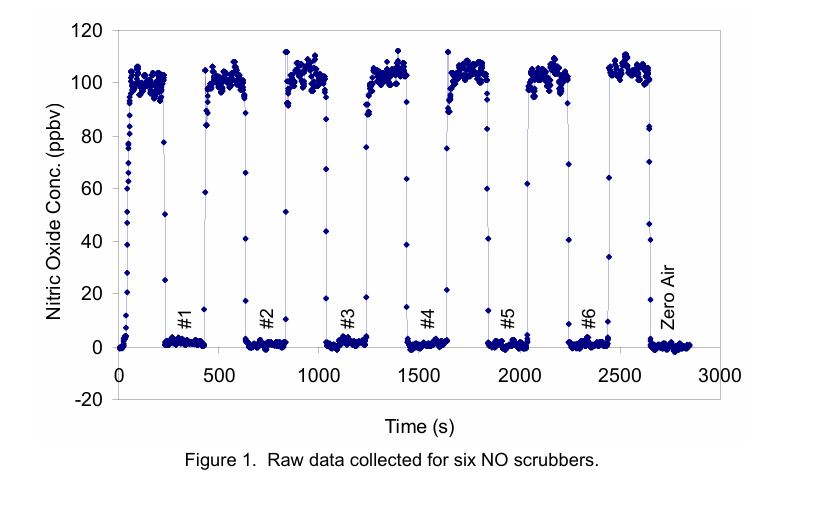
Measurements were made with each scrubber placed in-line, with the scrubbers bypassed, and with zero air flowing through the bypass. Figure 1 shows the NO concentration dropping to the baseline when each of the six NO scrubbers were put in line and when sampling zero air. For each of the scrubbers, the NO measurement was below the 1.7 ppb limit of detection for the experiment, where the limit of detection was calculated as 3 times the standard deviation of the zero air measurements. From this data, it is apparent that the scrubbers have maintained their ability to scrub NO after use in the field.